Getting started
Your first card show as a vendor: four rules, then everything else
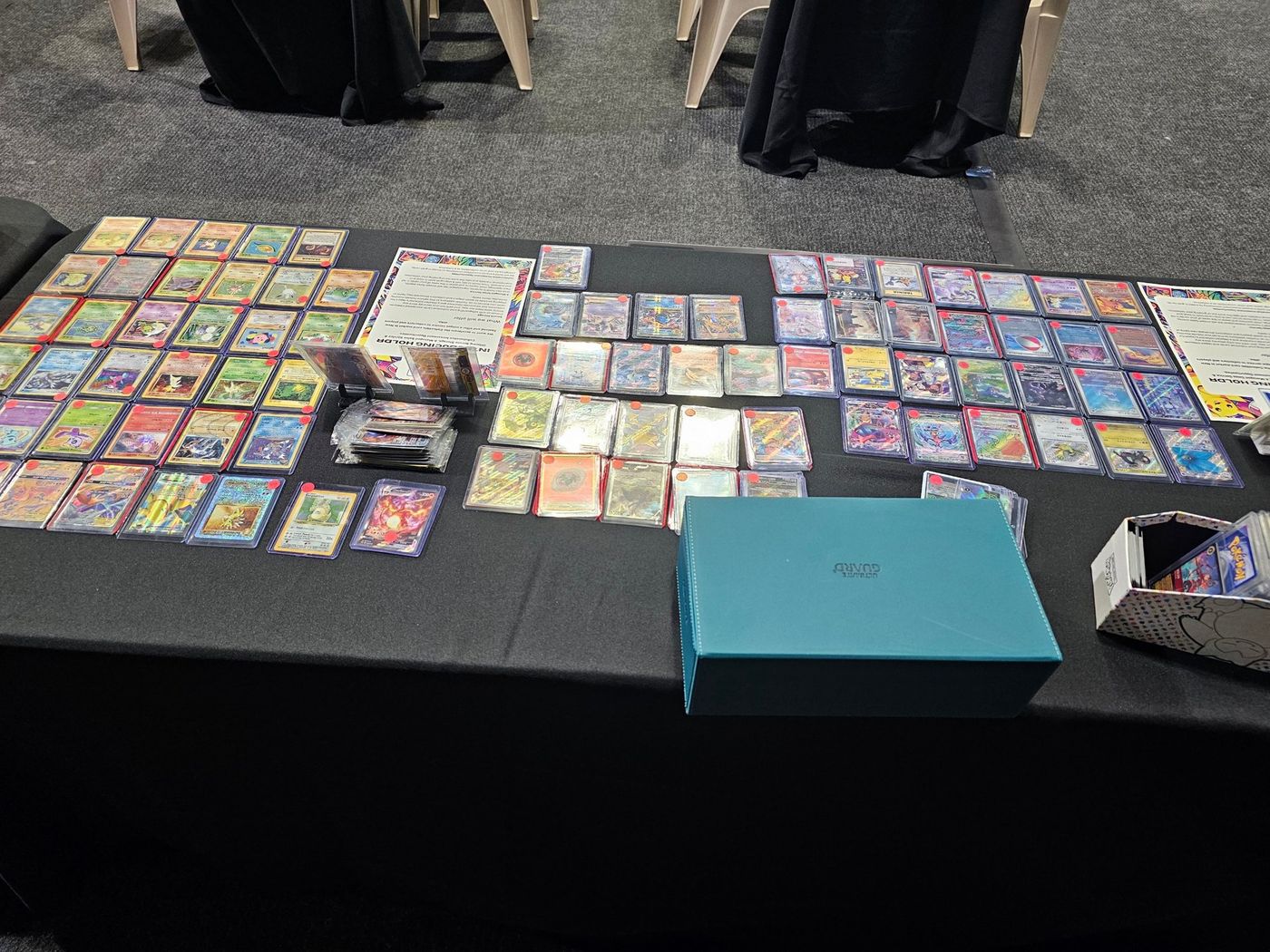
The short answer
Four rules matter more than anything else at your first show. Sticker every card. Set your buying rules and a goal before you go. Have everything prepared and packed the night before. And treat every customer like they will come back, because the good ones do.
When we started at Holdr four years ago we priced cards one at a time on our phones, did trades on a phone calculator, then in a scrapbook, and walked out of every show with cash in the bag and no idea whether we had made money. This guide is what we would tell ourselves at that first table.
The four rules
1. Sticker every card
Make it easy for people to buy. A price on the card means the customer does not have to ask and you do not have to look it up with a queue in front of you. When we started, most tables priced at whatever Collectr said and looked up every card at the point of sale. Stickers were faster then and they still are. They also work when the venue wifi does not.
2. Set your rules and your goal
Decide before the show what you are there to do and what you will pay. Without rules it is easy to spend far more than the show brings in.
“You may think it's great, but your bank balance may not.”
- Your rules: what percentage you pay for cheap and expensive cards, in cash and in trade; what you will not buy, such as new sets and cards that do not sell; and how much you will spend in total.
- Your goal: what a good day looks like. Sales above your costs for the day, or a target for buying.
3. Prepare everything
Stock chosen and priced, the kit packed, the float counted, and the table layout planned before you leave. The more chaotic the morning, the harder the whole day.
Be honest with yourself about time. Looking up and labelling a card by hand takes us 1 to 2 minutes. For 500 cards that is roughly 8 to 17 hours, before you have packed anything. Start early.
4. Look after your customers
You are there to build relationships: people who come back, who sell to you more than once, and who come to your stand first. Talk to people, be friendly, remember names and what they collect, and tell people your rules so they can choose to deal with you. We have customers who come back every single show.
“Hold a good reputation.”
Before the show
Pick the right first show
A local show is the best start. Travel and accommodation add real cost, and an away show has to earn that back. Ask the organiser about table size, load in time, power and whether there is signal. Ask other vendors too. They are generally a good crew and will tell you how big the crowd is and what sells.
Choose your stock
Bring a spread of prices. At our table most of the movement is cards between $5 and $50, and our sweet spot is $20 to $50. A few big cards draw attention and swing the day when they sell. Some vendors specialise in high value cards and do well. Decide what kind of table you are.
Know what you paid for every card
Without it you cannot tell whether a sale or a trade made money.
Bring cash, the right cash
Cash is still how most people pay. We bring a float of about $400 to $500: mostly $5 and $10 notes, coins and some $20s, and no $50s or $100s. If you plan to buy cards, bring extra cash for buying. We only pay cash when we buy at a show. Sellers like having money to spend at the show, and nobody waits on a transfer.
TenthPocket can help you price and label your stock before the show. Check your printer setup while there is time to test it.
Take card payments too
An EFTPOS or card reader, charged, plus a power bank. If you use TenthPocket, set up card payments before the show and check what card payments cost. Every way to pay you do not take is a sale that goes to the next table.
Avoid bank transfers at the table. They can be faked or reversed, and we have seen vendors hand over cards on a transfer that never arrived.
Pack the night before
Display
TableclothBindersDisplay casesPrice stickers and a penSign for the tableSelling
Card reader, chargedPower bankFloat in small notesSleeves, top loaders, bagsNotebook or appYou
Water and snacksWet wipesTrolleySmall cameraA helperThe full kit list is in the free printable checklist pack at the end of this guide.
At the show
Be ready for early access
The first buyers through the door often want to buy quickly, especially sealed product. If you sell sealed, have it out and priced before doors open.
Set up for security
Your side
Customer side
- Sealed product at the back of the table, never the front edge.
- Cases with no gaps at the sides, or kept closed.
- Somebody watching the binders the whole time.
- Cards a customer pulls out go on your side of the binder.
- A small camera on the table. It is cheap and puts people off.
Buy carefully, all day
Buyers bring cards all day, not just in the morning. Check every card before you agree a price: the right card, the right set and version, the right language, and its condition. Keep cards you are buying apart from your stock until the deal is done, and write down every card and its price.
Then get what you bought back out. Cards bought in the morning sell in the afternoon if they are priced and in the binder.
Record every sale, buy and trade as it happens
A notebook, a spreadsheet or an app. What matters is that it happens at the time, not from memory on Sunday night.
Keep going after lunch
The first day and the first half of the day are usually busier, but people buy and sell right through. Use quiet spells to walk the floor, restock and buy.
After the show
Cash up, and look at stock as well as cash
Counting the cash and checking the card reader tells you what came in, not whether you made money. For years we walked out with cash and felt good, then spent it all on stock for the next show. Look at what you sold, what those cards cost you, what you bought, what the day cost you, and what is left.
Write down what sold, what sat and what people asked for
That is your buying list for next time.
Follow up
Message anyone who asked you to look out for a card. They are your next sale.
How TenthPocket fits
Built at our table, for yours
We built TenthPocket for our own table at Holdr: photograph and price your cards, print labels, buy at the table from your own rates and rules, sell with no signal, and see stock and cash together at the end of the day.
To be straight about it: TenthPocket helps your second show far more than your first. The first time, every card goes in once. After that you only reprice the cards that have moved. At our table, prep that used to take one to two weeks before a show now gets done in a night.