Earnings
How to make more money at a card show: time, velocity and knowing your numbers
The short answer
A card show pays when cards move quickly at a margin you chose, when buying is fast and careful, and when you know your real numbers afterwards. Cash in the bag is not profit. Count what you sold, what it cost you, what you bought and what the day cost, then change one thing for the next show.
“At the end of the day, we're in a velocity game.”
Every card in your binder is cash you cannot spend until it sells. Everything in this guide comes back to that.
1. Know your break even before you book
Add up the day's costs: table, travel, parking, food, any helper, and for an away show, accommodation. Divide by your gross margin on what you sell. Gross margin is the share of the selling price left after the cost of those cards, not the markup on what you paid. That gives the sales you need to cover the day, before any costs left out of the example.
Worked example, made up NZD numbers
For example, NZ$1,000 in sales at a 30% gross margin leaves NZ$300 after the cards sold cost NZ$700. Subtract NZ$220 in show costs and you have NZ$80 left. This simplified example leaves out payment fees, tax and any other costs. Include applicable costs when working out your own result.
Away shows change the sum. Travel and accommodation can double the cost of the day, and you may find yourself doing deals you would normally pass on just to cover it. Run the numbers first, and ask vendors who have done that show how big the crowd is.
2. Save time before the show
Time is the cost most vendors never count. Looking up and labelling a card by hand took us 1 to 2 minutes. That is roughly 8 to 17 hours for 500 cards, and 17 to 33 hours for 1,000. It is why prep used to take us most of a week.
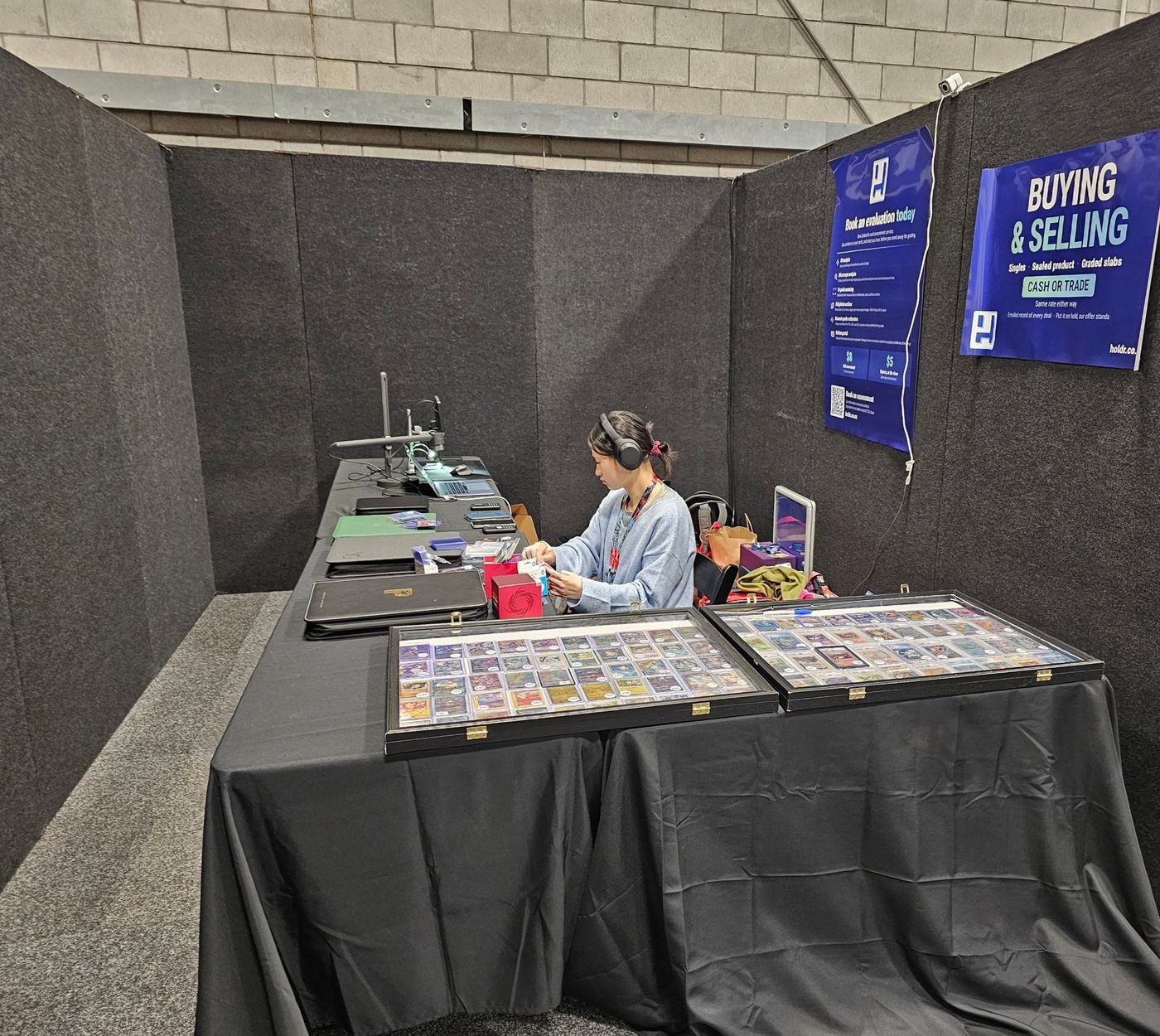
Our own numbers at Holdr's table, before and after TenthPocket. Your first show is slower, because every card goes in once.
- Do not reprice everything. Most cards have not moved since your last show. Only reprice the ones that have.
- Use a label printer. Printed labels are faster than handwriting and easier to read at the table. See how to price and label your stock before the show.
- Price close to the show. We once priced a graded card early in the week and it jumped about $500 overnight, so it sat on our table well under market. Pricing on the Thursday or Friday instead of the Tuesday keeps stickers closer to the market.
3. Bring the stock that moves
- Know which price band does the work. At our table most of the movement is between $5 and $50, and the sweet spot is $20 to $50. Big cards swing a day when they sell, and some vendors build their table around them.
- Sticker every card. Visible prices sell more, and every question about price costs you time with a queue.
- Leave home what sat last time, unless you have repriced it, or move it online.
- Have sealed product ready for early access. The first buyers through the door often want sealed and want to be quick.
4. Buying is where most of the money is made and lost
We have been hurt far more by buying the wrong card than by haggling or discounts.
- Different rates for different price bands. A flat rate across a whole lot loses its margin on the cheap cards, because those are the ones you round down and throw in for free.
- Tell sellers your rates. Honest rates mean fewer deals that fall over after you have priced every card.
- Prefer cards in for a card out. If someone wants one of your cards, put it into the deal first and trade towards it. You keep your cash and can see how close the deal is.
- Avoid new sets and slow cards. New releases often fall between one show and the next. Some cards just do not have many collectors.
- Check every card: right card, right set, right language, right condition.
- Get bought cards back out the same day. Cards bought in the morning can sell in the afternoon if they are priced and in the binder.
5. Make time for the people at your table
A 20 card buy, card by card
The same buy now
A 20 card trade done card by card used to take us 20 to 30 minutes. While we were heads down, other people looked through our binders with nobody helping them, and some walked away. Some of the best sales come from conversation: asking what someone collects, and pointing them to a card they had not seen.
Speed up buying, and if a deal is not coming together, say so early. The time you get back goes to the next customer.
6. Discount with a ceiling
Haggling is part of a card show. Decide your limits before the day. We try not to go beyond 10 percent off a total, and it depends on whether it is a regular. Small discounts are fine. Lots of them, on cards you bought at a high rate, add up.
7. Take cash and card
Cash is still how most people pay, so bring a float of small notes. Take card on an EFTPOS or card reader too. If you use TenthPocket, set up card payments and check the payment fees before the show. Avoid bank transfers at the table; they can be faked or reversed. When you buy, paying cash is quick and sellers can spend it at the show.
8. Build customers, not just sales
People who come back every show are worth more than any single sale. Remember names and what people collect. Let people who met you at a show see your cards online afterwards, and offer to bring a card to the next show for pickup.
9. After the show: cash in the bag is not profit
For years we walked out of every show with cash and card takings and felt like we had done well. Then the money went straight back into cards for the next show.
“You assume you're doing well, but how well are you actually doing?”
What it feels like
What actually tells you
Equals
| Check this | What it tells you |
|---|---|
| Sales | How much came in |
| Profit on cards sold | Sales minus what those cards cost you. Whether the selling was worth it |
| Stock purchases | Cash spent restocking. Record it separately from the cost of cards sold; unsold cards have not earned a profit yet |
| Stock on hand, start and end | What stock remains at cost. Keep estimated resale value separate from realised profit |
| Costs of the day | Table, travel, food, accommodation and payment fees |
| Cash up: over or short | Whether your records are right |
| What sold, sat and was asked for | What to bring, drop or look for next time |
The first time we saw all of this together, the surprise was the trades. In one deal we took in 50 or 60 smaller cards for one big card that had sat with us for a long time. Smaller cards carry more margin under our buying rules, but they may take longer to sell, so we will watch them.
Buying new stock changes your cash balance. It does not change the profit on cards already sold. Record your stock between shows separately so it is not counted twice.
10. Turn the numbers into decisions
| If you see | Try |
|---|---|
| Sales high, profit low | You are paying too much when buying, or discounting too hard |
| Lots of interest, few sales | Prices not visible, or the middle of your price range is too thin |
| The same cards come home every show | Reprice, bundle, or sell them online |
| People ask for something you lack | Make it this week's buying target |
| Cash short every time | Write down cash buys at the moment you pay |
| Below break even twice in a row | Smaller table, a different show, or treat it as a buying day |
| Lots of slow cards from trades | Tighten your buying rules for that kind of card |
How TenthPocket fits
Built at our table, for yours
We built TenthPocket so these numbers appear on their own. Every card keeps what you paid, buying rules stop slow cards coming in, a stack is photographed and priced by condition in minutes, it works with no signal, and the show report puts sales, buys, margin, stock and cash together at the end of the day.
It helps the second show far more than the first, because the first time is when your cards go in.